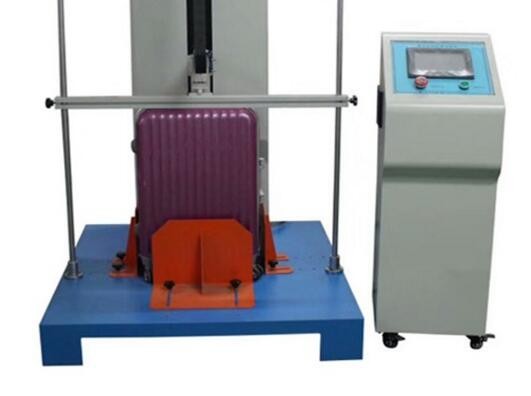
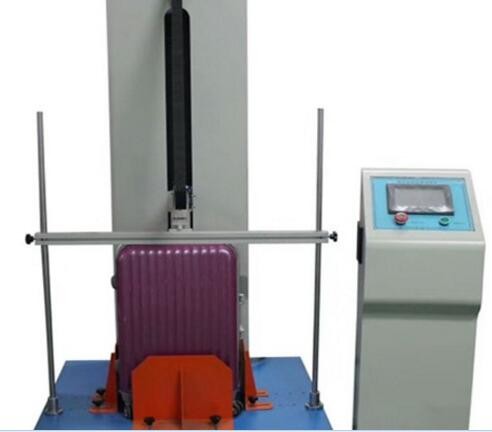
Luggage Testing Instrument Rod Reciprocating Machine
Product Application
Luggage rod fatigue Testing machine applies to the fatigue test of the rod attached on the luggage.During the test, the rod is stretched,which leads gaps,loosing,barrier and deformation of the rod.
Using area:luggage rod fatigue tester, reciprocating tester
Technical parameters
| Test Stroke |
20-100cm Adjustable |
| Drawing Speed |
0-30cm/sec Adjustabel |
| Compression Speed |
0-30cm/sec Adjustabel |
| Test times |
1-999999 Automatic shutdown |
| Test power |
Pneumatic cylinder |
| Specimen height |
Hightest 200cm |
| Auxiliary equipment |
Bags fixed clamp |
| Pressure |
5-8kg/cm2 |
| Machine size |
120×120×210cm |
| Weight |
150kg |
| Power |
1ø, 220V/50Hz |
Applications
-
Fatigue testing of telescopic pull rods on luggage and travel bags
-
Quality control inspection for luggage manufacturers
-
Product development and design validation of new rod mechanisms
-
Detection of rod loosening, jamming, clearance issues, and deformation
-
Supplier qualification and incoming material inspection
-
Research and development in luggage and travel goods industries
-
Compliance testing for retail buyers and brand quality assurance programs
Frequently Asked Questions
Q1: What is this equipment used for?
This machine tests the fatigue durability of telescopic pull rods on luggage and travel bags. It identifies issues like loosening, jamming, excessive clearance, and deformation that occur after repeated extension and compression cycles.
Q2: How does the machine work?
A pneumatic cylinder drives the luggage rod through repeated extension and compression movements at adjustable speeds and stroke lengths. The machine runs until the preset cycle count is reached, then shuts down automatically.
Q3: What standards does this equipment comply with?
The current product documentation does not specify particular ISO, ASTM, or other standards. We recommend confirming your required test protocols prior to purchase.
Q4: What types of luggage can be tested?
The machine accommodates luggage rods up to 200 cm in height, making it suitable for most suitcase and travel bag sizes, from carry-on to large checked luggage.
Q5: What parameters can be adjusted during testing?
You can adjust the test stroke (20–100 cm), extension speed (0–30 cm/sec), compression speed (0–30 cm/sec), and total cycle count (1–999,999 cycles).
Q6: What air pressure is required for operation?
The machine requires a compressed air supply at 5–8 kg/cm² to power the pneumatic cylinder.
Q7: What industries use this equipment?
Luggage manufacturers, quality assurance laboratories, retail buyers conducting supplier audits, and research institutions in the travel goods industry.
Q8: What is the maximum load capacity?
The machine supports a maximum load of 50 lb.