Trusted for railway, automotive, and building – NF P 92‑505 gives you clear, fast M‑classification.
Product Overview
The dripping test according to NF P 92-505 is a reaction to fire complementary test for M classification of building and fitting materials. It is used for thermalmelting materials for which some inflamed or not dripping, produced by a heating source, were noticed during the main test. This one can be either the electrical burner test for flexible and thin materials (NF P 92-503), or the radiation test (epiradiator cabinet) for rigid or flexible and thick materials (NF P 92-501).
Technical Overview
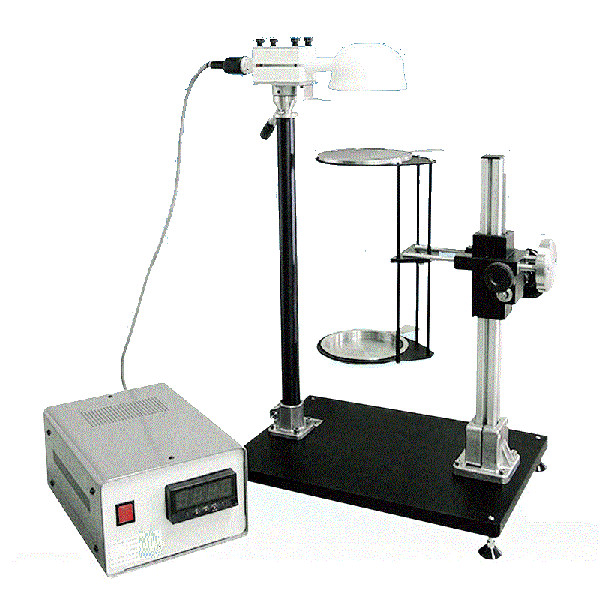
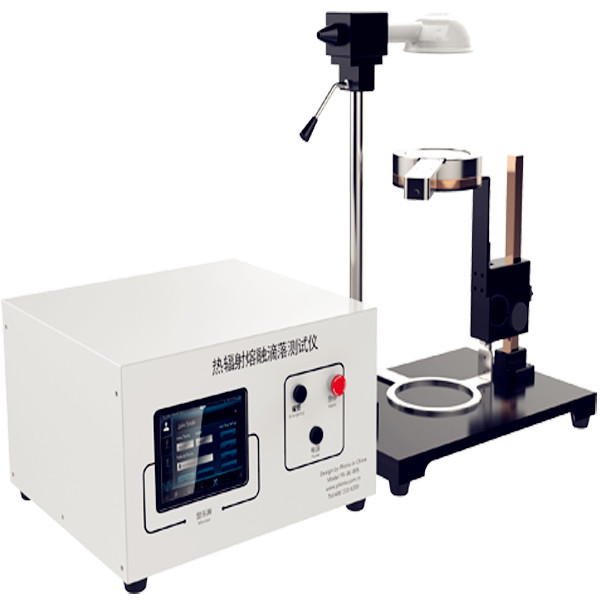
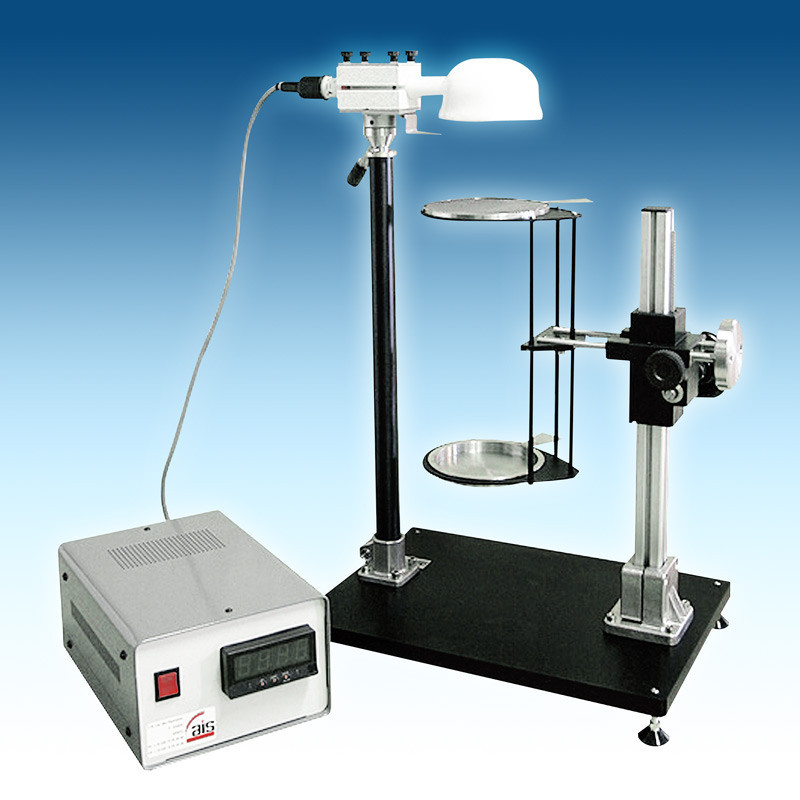
- Radiant source – 500 W epiradiator, 100 mm fused silica disk
- Movable handle – Lifts and rotates epiradiator 90° for specimen access
- Specimen holder – Metal ring with stainless steel wire grid
- Drip receiver – Cotton‑wool dish, positioned 300 mm below specimen
- Distance gauge – Guiding mark + graduated rule for 30 mm spacing
Test parameters:
The specimen (70 mm × 70 mm) is placed horizontally 30 mm below the radiant surface. The test runs for 10 minutes; if the specimen ignites within the first 5 minutes, the radiator is removed.
Classification principle:
If the cotton wool in the receptacle ignites, the material is classified as M4 (high flammability). If the cotton wool does not ignite, the classification from the main test is either maintained or the material is downgraded, depending on whether uninflamed or inflamed dripping occurred during the main test.
Standards
NF P92-505,EU 95/28/EC
Application
Application sectors – Building materials, railway (NFF 16‑101), automotive (EU 95/28/EC, ECE R118), aerospace, marine, cable, and furniture.
Materials tested – Thermoplastic films, foams, textiles, composites, and other thermal‑melting materials.
Compliance – French M‑classification and international fire‑safety standards.
Frequently Asked Questions
Q1:What does the NF P 92‑505 test measure?
A1: It measures whether molten drips from a heated specimen ignite cotton wool, directly affecting the material’s M classification (M0–M4).
Q2:When is this test required?
A2: When dripping is observed during the main test (NF P 92‑501 for rigid/thick materials, or NF P 92‑503 for flexible/thin materials).
Q3: What happens if the cotton wool ignites?
A3: The material is automatically rated M4 (highest flammability).
Q4:What materials are suitable for testing?
A4:Thermal‑melting materials such as thermoplastics, flexible foams, synthetic textiles, composite laminates, and cable insulations.
Q5:How is the apparatus calibrated?
A5: Using a calorimeter (NF P 92‑505) and a water‑cooled heat flux meter (ECE R118 Annex 7) for precise radiant output.
Q6:Does it meet other international standards?
A6: Yes – it complies with NF P 92‑505, EU 95/28/EC, and ECE R118 Annex 7, making it suitable for global automotive, railway, and construction testing.
Aftersales service and technical support
Oneyear aftersales support, lifetime technical assistance
Equipment installation and calibration
Calibration services
Support for the development of testing methods
Technical training
Contact information
To obtain the complete technical specifications, a quote, or to schedule a demonstration, please contact our sales team or authorized dealers. We will provide you with professional and prompt technical support and services.